read the article

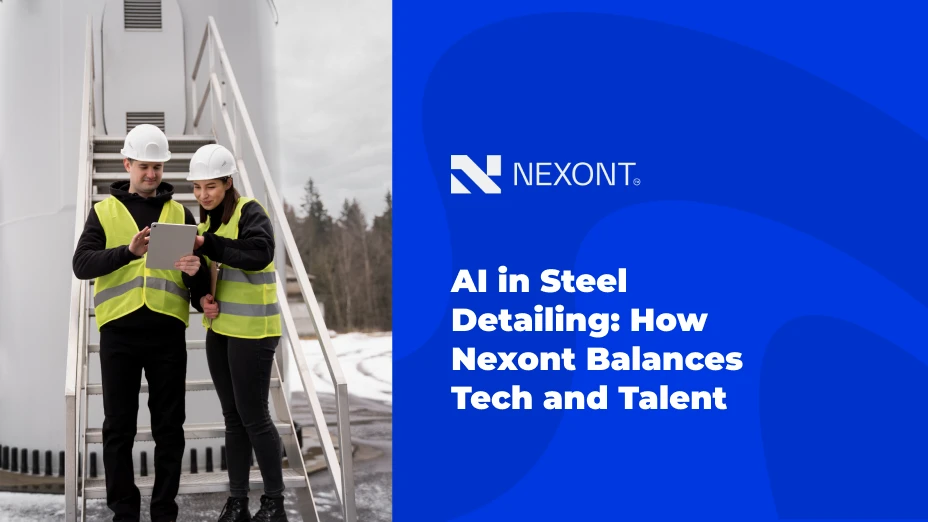
Introduction
In recent years, artificial intelligence (AI) has redefined how industries operate—and the world of structural steel detailing is no exception. Once a labor-intensive, purely manual domain, detailing is now being transformed by AI-assisted tools, automation, and smart integrations. The question is no longer “Will AI replace detailers?” but rather “How can AI empower them?”
At Nexont, we see AI not as a threat, but as a powerful partner. In this blog, we’ll share how AI fits into the modern detailing workflow, how we use it across platforms like Tekla and SDS2, and why human expertise remains irreplaceable.
The Role of AI in Steel Detailing

Steel detailing involves producing accurate drawings and models that bridge the gap between design and fabrication. It requires precision, standards compliance, and deep engineering judgment. This is where AI enters—not to replace—but to optimize and assist.
AI in steel detailing can:
- Automate repetitive tasks (e.g., connection detailing)
- Detect clashes or compliance issues earlier
- Generate parametric models and macros
- Improve revision tracking and communication
- Analyze productivity trends and estimate accuracy
Tools like Tekla Open API, SDS2 Plugins, and Notion AI are driving this change by integrating automation into the everyday life of detailers.
Nexont’s Perspective: AI as a Strategic Partner
At Nexont, our philosophy is simple: AI should support the expert, not replace them.
We use AI to:
- Save time on mundane tasks
- Reduce rework by catching errors early
- Enhance creativity by offering faster concept visualization
- Maintain quality while scaling operations
Rather than replacing engineers or detailers, AI at Nexont acts like an assistant—drafting, checking, forecasting, and guiding—while humans make the final call.
We’re not interested in automating away expertise. We’re interested in building tools that let our team focus on what truly matters: quality, precision, and engineering judgment.
How Nexont Applies AI in Real Workflows
Here’s how AI fits into our daily systems at Nexont:
1. AI-Assisted Project Management
- Notion AI: Summarizes meetings, creates briefs
- ChatGPT (Custom GPTs): Drafts RFIs, emails, and reports
- Clockify/Hubstaff: Provides time-tracking insights using AI productivity analytics
2. Tekla and SDS2 Automations
- Parametric Macros: For repetitive handrails or stair detailing
- Tekla Open API Scripts: Auto-check drawing compliance, revisions, and naming
- SDS2 Plugins: Automate clip angles and baseplates
- Excel Integrations: Link material lists and track revisions efficiently
3. Workflow Optimization Tools
- ChatGPT: Helps write weld notes, RFIs, or style guides
- Stable Diffusion or Midjourney: Used for internal concept visualizations
4. Reporting and Analytics
- Power BI with AI insights: Tracks time deviations and productivity trends
- Smart Timesheet Tools: Spot overages or underperformance before they affect delivery
These tools are not theoretical. They are live, tested, and embedded in our system—and the results show: faster cycles, fewer mistakes, and better clarity for our teams and clients.
The Human Touch: Why Detailers Still Matter

Despite all the tech, one thing remains constant: AI doesn’t make decisions—people do.
AI might draft a weld note or check a drawing, but it’s the experienced detailer who decides whether it’s right. The art of reading between the lines, interpreting unclear inputs, and collaborating with architects and fabricators—those are human skills.
Nexont doesn’t just believe in using AI. We believe in using it responsibly, guided by talented professionals who understand both the craft and the code.
Conclusion
The future of steel detailing isn’t about man versus machine. It’s about collaboration.
At Nexont, AI is part of our detailing team—but the brain, the judgment, and the decision-making still belong to our engineers. By using AI as a tool—not a replacement—we’re building a future that’s faster, smarter, and more human than ever before.
recent post